
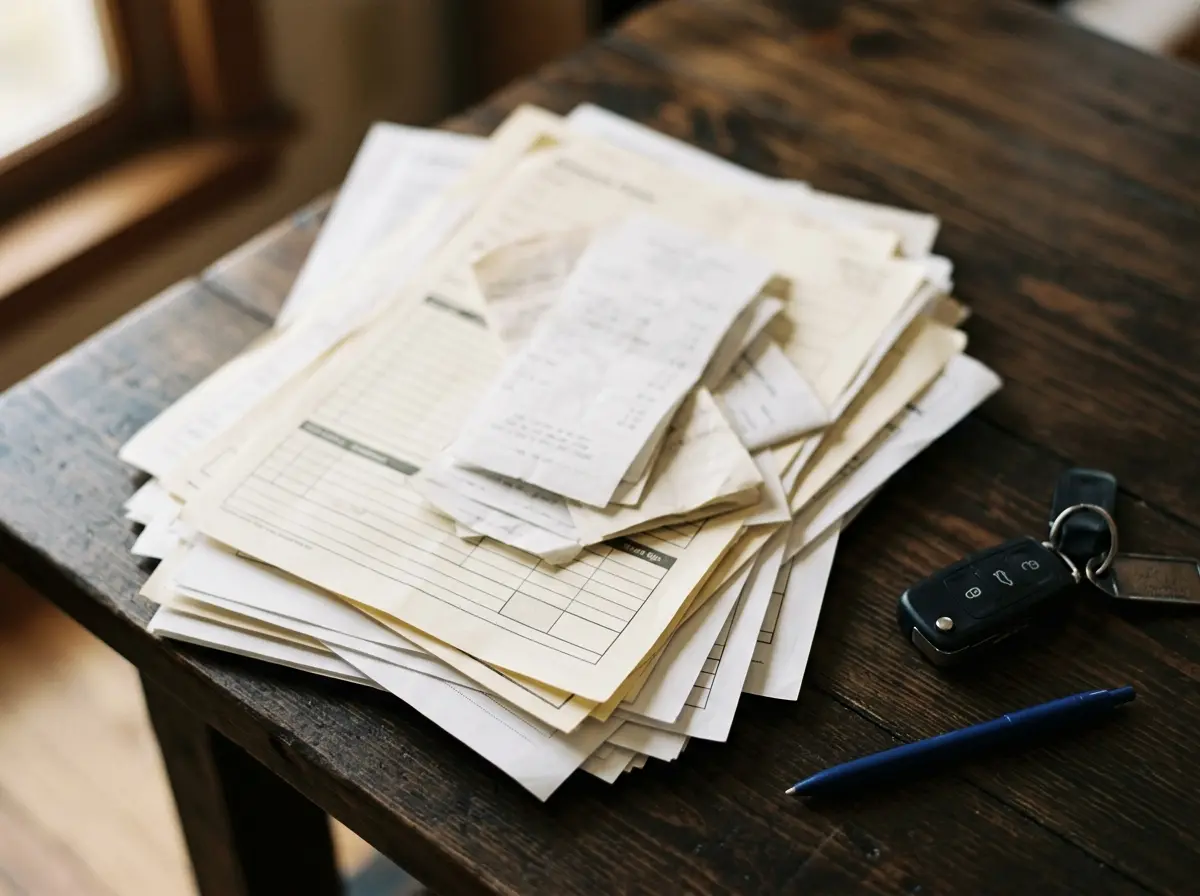
A California lemon law claim is mostly a paper case. Repair orders, the warranty booklet, the sales or lease contract and a few letters usually decide whether the manufacturer has to take the car back, long before anyone sees a courtroom. The steps below split partway through, because since 2025 some manufacturers follow a newer set of procedures and others do not. If you are still working out whether your car qualifies, read how California lemon law works first.
Step 1: Build the repair record as you go
A repair order is the written record the dealer opens every time your car comes in. Get a copy at every visit, including the ones marked "could not duplicate," because they still show you reported the problem and gave the manufacturer a chance to fix it. Before you leave, check the date in, the date out, the mileage, and whether your complaint is written the way you described it. "Customer states noise" is far weaker than "grinding from front left wheel when braking above 40 mph." Ask for corrections before you sign, since a visit that isn't on paper is very hard to prove later.
Keep everything else in one folder: the sales or lease contract, the warranty booklet, loan statements, and receipts for towing, rental cars and repairs you paid for. Those out-of-pocket costs can be recovered as incidental damages, but only if you can show them. Note how many days the car sat at the dealer, too, since total days out of service count toward the 30-day benchmark.
Step 2: Give the manufacturer its chances to repair it
The law does not set a fixed number of visits. It requires "a reasonable number of attempts," and the California Department of Consumer Affairs (DCA) says there must be at least two. Under Civil Code section 1793.2(b), warranty repairs generally have to be finished within 30 days unless you agree in writing to more time. The familiar 18-month or 18,000-mile benchmarks create a presumption that helps prove a case, not a deadline, and the lemon checker walks through them. If a problem makes the car unsafe to drive, don't drive it. Ask the dealer to tow it in.
Step 3: Send direct notice if your owner's manual requires it
Some manufacturers print a notice in the warranty booklet or owner's manual telling you to write to them directly. If that notice is clear and conspicuous, the repeat-repair presumption (two attempts for a defect likely to cause death or serious injury, four for any other defect) only applies if you notified the manufacturer directly at least once, at the address it lists. The more-than-30-days test has no such requirement. Send a short letter naming the defect and the repair dates, and keep proof of delivery. This letter is separate from the formal pre-suit notice in Step 6.
Step 4: Decide whether to use the manufacturer's arbitration program
You do not have to arbitrate before hiring a lawyer or suing. It matters in one situation. If your manufacturer runs a state-certified program and told you about it in writing in time, you cannot rely on the repair presumption in court until you have used that program first (Civil Code section 1793.22(c)).
Certified programs are free to consumers. The DCA says decisions usually come within 40 days and bind the manufacturer only if you accept them, after which the manufacturer has 30 days to perform. If you turn a decision down, you can still sue, and the filing deadline is extended by the days the arbitration was pending. The state also warns that attorney's fees for arbitration may not be covered. The DCA's arbitration program page lists which program each participating manufacturer uses.
Step 5: Talk to a lawyer and read the fee agreement
From your repair orders and contract, an attorney can tell which procedures your manufacturer follows and how much time is left. Lemon law filing deadlines depend on the manufacturer and the warranty, and they can be shorter than people expect. If you win, Civil Code section 1794(d) requires the manufacturer to pay your reasonable attorney's fees and costs. Your agreement with your own lawyer must still be in writing, and Business and Professions Code section 6147 requires it to state the fee rate, explain how costs affect your recovery, and say that the fee is not set by law and can be negotiated. Ask what happens to costs if the case recovers nothing. Our page on who pays a lemon law attorney has more questions to ask.
Step 6: The written demand to the manufacturer
Next, your lawyer asks the manufacturer in writing to repurchase or replace the car. What that letter must contain depends on whether the manufacturer opted into the procedures created by AB 1755. The DCA keeps the list of manufacturers that opted in, and it is republished by December 15 each year. Our explainer on the 2025 lemon law changes covers how those elections work.
Opted-in manufacturers: the pre-suit notice
To keep the right to seek a civil penalty, you must send written notice at least 30 days before filing suit (Code of Civil Procedure section 871.24). It gives your name, the car's correct VIN and a short repair history, and it demands repurchase or replacement. It goes by email to the address the manufacturer posts on its website for this purpose, or by certified or registered mail to the address in the owner's manual or warranty booklet. Manufacturers must publish that contact information in English and Spanish.
Then a clock starts. If the manufacturer offers a repurchase or replacement within 30 days of receiving the notice (plus reasonable attorney's fees, if you have a lawyer) and completes it within 60 days, no civil penalty is allowed. A notice received on March 3 means an offer is due by April 2 and the buyback must be finished by May 2. You must have the car when you send the notice and keep it at least 30 days, or the full 60 if an offer comes.
If no offer arrives within 30 days, you may sell the car and still sue, civil penalty included, as long as you give the buyer written notice of your claim before the sale. Fee disputes at this stage go to neutral, binding arbitration. You can also skip the notice and sue for a buyback right away, but then civil penalties are off the table.
Manufacturers that did not opt in
No statutory 30-day offer window applies, but a demand letter still does one specific job under Civil Code section 1794(e). Sent after the events that create the repair presumption, it preserves a possible civil penalty under that subdivision, unless the manufacturer complies within 30 days or maintains a qualified arbitration program. The separate penalty for willful violations, in section 1794(c), does not depend on it.
Step 7: If the claim becomes a lawsuit
Opted-in manufacturers: early disclosures and mediation
AB 1755 put these lawsuits on a fixed early schedule, counted from the day the manufacturer files its answer.
| Days after the answer | What has to happen |
|---|---|
| 60 | Both sides hand over a set list of documents and facts without being asked |
| 90 | Mediation must be scheduled |
| 120 | Window for initial depositions (two hours each) closes |
| 150 | Mediation must take place |
Your side of the exchange includes the contract, registration, payment history and payoff, every repair order, and proof of incidental damages. The manufacturer must produce the car's entire warranty history and related technical service bulletins. Other discovery waits until mediation ends, and courts must sanction lawyers who ignore the document or deposition rules, at $1,500 for the consumer's attorney or $2,500 for the manufacturer's.
Other manufacturers: the traditional path
These lawsuits follow ordinary civil procedure. Both sides exchange documents and take depositions, and the case may go to mediation before trial. No statute sets the pace, so the length depends on the court's calendar and on when settlement talks get serious. Formal settlement offers under Code of Civil Procedure section 998 need care. In Madrigal v. Hyundai Motor America (2025), the California Supreme Court held that a consumer who rejects one and settles later does not necessarily avoid its cost consequences.
Step 8: The release and buyback day
Every buyback ends with a signed release. Opted-in manufacturers cannot require any release other than the Standardized SBA Release written into Code of Civil Procedure section 871.25. Under it, the manufacturer pays your remaining loan or lease balance directly to the lender, with interest through the payoff date but not late fees. You receive your restitution check when you return the car, and a payment you make after the numbers are set is reimbursed within 30 days of your proof. The release covers claims about the purchase, lease, condition, use or repair of the car and takes effect when you return it. With other manufacturers the release is negotiated, so ask your lawyer which claims you are giving up and when each payment is due.
On buyback day, you sign the documents that transfer ownership and turn in the car. For opted-in manufacturers, the restitution funds are due at the return, the loan payoff within one business day, and the whole buyback within 30 days of the signed release, or the manufacturer owes $50 a day until it is done. Other manufacturers follow the schedule in the settlement. Keep making your loan or lease payments until the lender confirms the payoff, since the standard release does not cover late fees. For what the refund itself includes, see what a lemon law buyback covers.
Start with the paperwork you already have
Put your repair orders in date order this week. Circle the mileage on the first one for this problem, because that number drives the usage offset, and the buyback calculator shows how. Then find the lemon law page in your warranty booklet. With those in hand, request a free case review, and an attorney will tell you which path your manufacturer is on and what the first letter should say.
Updated October 2, 2026
Common questions
How long does a California lemon law claim take?
There is no single timeline. Some steps have clocks set by statute. For manufacturers that opted into the 2025 procedures, an offer is due within 30 days of a pre-suit notice and a completed buyback within 60, and a lawsuit must reach mediation within 150 days of the manufacturer's answer. Certified arbitration usually produces a decision within 40 days. Lawsuits against other manufacturers have no fixed schedule, and their length depends on the court and on when the case settles.
What happens if the manufacturer ignores my demand letter?
It depends on the manufacturer. If it opted into the 2025 procedures and makes no offer within 30 days of receiving a proper pre-suit notice, you may file suit, civil penalty claim included. For other manufacturers, the next step is usually arbitration or a lawsuit. A written demand sent after the events that create the repair presumption also preserves a possible penalty under Civil Code section 1794(e) if the manufacturer fails to comply within 30 days, unless it runs a qualified arbitration program.
Can I trade in or sell the car before the claim is resolved?
Talk to a lawyer first. In Niedermeier v. FCA US (2024), the California Supreme Court held that a trade-in credit or sale proceeds do not reduce restitution, at least where the owner was forced to trade in or sell because the manufacturer failed to comply. Opted-in manufacturers come with possession rules: you must have the car when you send the pre-suit notice, keep it at least 30 days after the manufacturer receives it (60 if an offer is made), and have it when you file if you skip the notice. Selling after 30 days with no offer keeps a civil penalty claim alive only if you give the buyer written notice of your claim before the sale.
Will my lemon law case go to trial?
Not necessarily. A claim can end at several points before trial: an offer after the pre-suit notice, an arbitration decision you accept, a settlement at mediation, or a negotiated settlement later on. Some cases do go to trial, and no lawyer can promise that yours will not.
What should I bring to a lemon law case review?
Every repair order for the problem, the sales or lease contract, the warranty booklet, your latest loan or lease statement, and receipts for towing, rentals or repairs you paid for. Bring any letters or emails with the manufacturer too. Missing a few pieces is normal. In a lawsuit against an opted-in manufacturer, the manufacturer must produce the car's entire warranty history, which can fill gaps in your own records.